Creative flow & my writing process
This work is licensed under CC BY-SA 4.0
Research as a leisure activity is a succinct summation of much of my spare time. There’s nothing I enjoy more than to spend an hour or two disappearing into a wikipedia rabbit hole. Research and learning is an endless joy. Along the way, I accumulate dot points with ideas, quotes, and unstructured text in my notes app. It becomes a wild landscape, an uncultivated garden of new ideas and ways of thinking.
This love of learning isn’t free - my garden of ideas will usually start to sprawl well past the original subject I started with. The landscape becomes tangled, and dense with many related parts. It is at this point that I pause to choose one of two paths - either put the subject down (to be revisited/recycled for later work), or create something meaningful with the garden of ideas I’ve built.
Doing something with this research, creating something useful and shareable is how I wound up starting Endpapers. It gives me my own place to write about what I find, and to share it so others can enjoy it. That said, writing is hard - it’s hard to align slippery thoughts and ideas into something that flows in a logical and linear fashion.
"Throw up into your typewriter every morning. Clean up every noon."
– Raymond Chandler
To help me straighten out my tangled notes into a coherent piece of writing I write a zero draft (or a shitty first draft, as Anne Lamott puts it). It acts as a filter to help me extract the most salient and gripping ideas from my notes. This works on the principle of “if I remember it, it’s probably important”. Typically the zero draft is a long scroll of rambling prose. It doesn’t matter how bad it is. The point is to get the writing in prose and on paper so it can be edited. Good writing doesn’t spring from nothing - it’s shaped, polished, and completed in editing. If woodwork is 90% sanding, writing is 90% editing and rewriting.
This is a good thing. It frees me (and you) from the predations of thinking “what if it sucks”. The first draft of anything always sucks. Great writing does not happen ex nihilo, it happens when you put on your editing hat and make that first draft great.
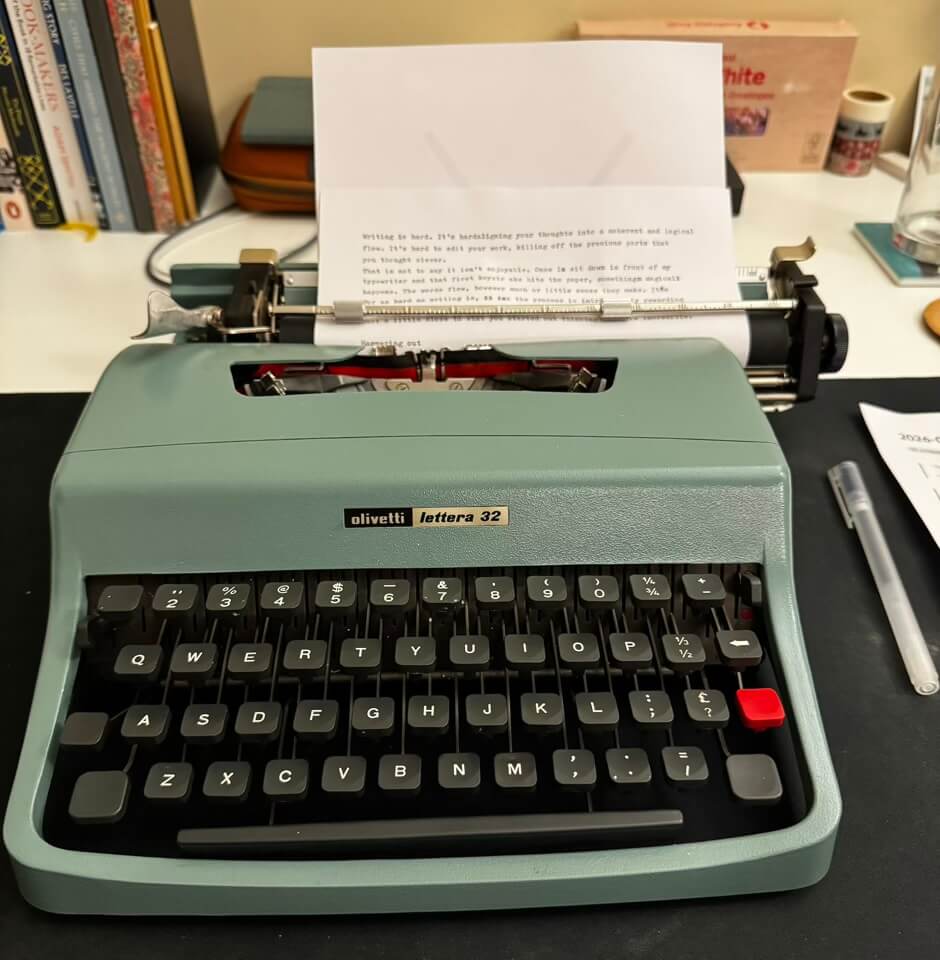
The goal therefore is to get that first draft on paper with as little distractions as possible. I typically write these articles in either markdown or on my typewriter (if I’m stuck or just bored). To keep the flow of writing, I have a rather spartan style guide that I use for drafting -
- Headings are in all capitals, with a period at the end - “HEADING EXAMPLE.”
- No lists - this one is personal preference. I have an annoying habit of using dot points to avoid starting the hard work of hammering out prose (and the attendant thinking that requires).
- No text decoration - no italics, bold, underline, etc.
- Use TK marks - if an idea for expanding a paragraph, or changing it springs to mind while editing, I use a TK mark to note it down so I can move on. These look like this: TK: note to self.
Despite the ease at which I can use all these things in markdown, the change from writing to editing breaks my writing flow. If I want a complete draft, these breaks must be minimised. Thus, the style guide is brutalist and simple. It also helps that it works equally well for writing on my typewriter as on my computer.
If a carpenter needs wood to sand, a writer needs a draft to edit. Once that draft is in hand, the real fun begins - it’s like research, but you’re excavating a logical narrative thread from your draft instead of from books/articles/and the internet.
My editing process begins with a pen and paper. I print out the zero draft, and attack it over a cup of coffee with my favourite gel pen. The change in medium helps me to see the work with fresh eyes. I’m usually looking for both proofreading, and editing opportunities here - equally likely to add a mark to capitalise a letter as I am to cross out a sentence and add a reworded version to the margins.
If I’ve found a lot of structural issues with the draft, I will typically type it back in by hand - giving myself the chance to reforge it as I digitise the edits. If the edit phase wasn’t quite so violent on my draft, I will open the zero draft and make the changes.
The work I publish here on Endpapers typically goes through no more than two drafts/edit cycles. I find if I do more than that (especially for longer pieces), the ideas get overworked and flattened out, like butter spread over too much toast.
For your own work (writing or otherwise), try separating the creation phase from the edit phase. You may find the single-minded focus to be a simple way maximise the time you spend in each stage.
No spam, no sharing to third party. Only you and me.