Field notes - Disney concept artists & surveillance webs

Last week I started working through Drawabox for the second or third time. I have a feeling this time might stick - I've found a monthly sketching class to accompany the solo practice. My desire to draw, mostly for comics/stories, has been growing over the past year or two. I've made progress on learning how to set myself up for success in the solo practice too - instead of willpower, I'm using habit.
I read Charles Duhigg's "The Power of Habit" last year. I'm sure the actual science is messier than his framework. But the framework has proven itself useful to me a number of times, both in just understanding my own habits, and correcting/creating new ones. This is what I'm building as the foundation to learn to draw - a regular habit, with a defined cue, routine, and reward.
Continuing on the art theme for this week I've stumbled across work from two Disney artists; specifically Paul Felix and Jazno Francoeur. Paul's work spans films such as Lilo and Stitch, Tarzan, and Big Hero 6. It's a joy to browse through his concept art for the better side of Disney's back catalog, and see how the magic came to life.
Jazno Francoeur has worked on Tarzan, The Emperor's New Groove (which had a working title of "Kingdom of the Sun" apparently). Take a browse through the concept art for the Hunchback of Notre Dame, or the 10 style guides that he's uploaded. A great resource, even if only to take a peek inside a beloved childhood film.
Rounding out the art round up is an animated series to keep an eye on. Electro Andes is a cyberpunk story set in South America. A setting that isn't Japan or the USA is refreshing - the rest of the world is often overlooked in favour of retreading the same familiar settings for these stories. There's a whole world out there to set your next story in.
I hope Bellolandia gets the funding to finish this (from Patreon, or a publisher). It looks like an amazing project.
Story Inspiration of the week
For this week's inspiration, I wanted to give you something more plot centric than the last few issues. I love a good macguffin as much as the next person, but I had a cracker of an idea for a story that I'm sharing today. It's less a set of links, and more some original story planning for you to enjoy and be inspired by.
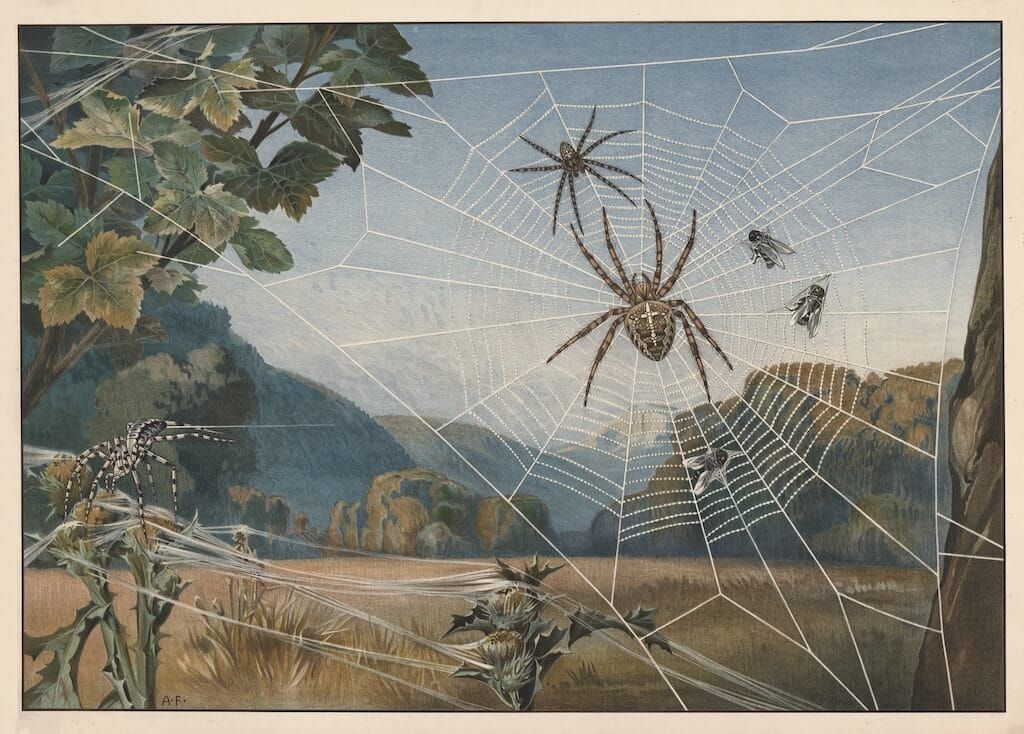
The Spider's Web
"It wasn't illegal. That's what the suits said when I found out. We're only using public data, and metadata legitimately obtained. Everything the Stasi did was legal too. That doesn't make it right. We were trapping people, destroying lives without them ever knowing what had been done to them. We had seized the cold hand of fate and begun to play god."
– Anonymous whistleblower; death certificate stated 'natural causes'.
The year is 2042. The USA's Darien scheme - generative AI dominance - has imploded, taking with it the country's last hope of relevance on the world stage. One particular company emerged from the rubble to exploit all the now idle compute capacity littering the globe: Valdheim Industrial. In the 20th century, they had manufactured flatware - knives, forks, that kind of thing. The geometric growth of the technology industry saw Valdheim enter a new vertical: surveillance.
At first it was software and tech for police forces. Body cameras, provenance of footage for court cases, that kind of thing. Around 2025, they discovered a new demand they could sell into, one that would need some capex to succeed. So, while the world was going mad for LLMs, Valdheim was build their next offering.
Spider's Web. That was their internal name for the tool. In a way, that's exactly what it was. A massive network of connections built with metadata from contracts with state and federal government departments, and all the public data they could scrape legally. Photos from social media, ANPR feeds, live webcam feeds, phone call, text message, and email metadata. That kind of thing. It wasn't the content, but it was when, where, and who you'd been interacting with.
A mycelium network, fungal spores of data in a vast network covered in spiders racing to feed predictive models.
They'd charted the entire lives of people, and with the right predictive algorithms, they were able to sell it. Law enforcement loved it; much better than their current software packages for finding known associates and potential co-conspirators. Valdheim even sold a version to private business as a way to reduce retail theft (in exchange for their CCTV feeds, naturally).
But that was not what Valdheim had set out to build. The architect of the Spider's Web, a man called Golitsyn, had sold upper management on "broad scale predictive analytics". What he meant by that was a system that could find leverage points for directing large groups of people. You could query the datastore they had with any name, and get a report that would tell you where that person was most vulnerable, and how they could be pushed to action one way or another.
If the spider's web knew everyone you contacted, every website you visited, every photo (with facial recognition processing), what would a predictive model be able to say about you? What would it be able to say about the directions of the groups you associated with? What could a corporation do with that?
Would it be like Kmart sending customised catalogs to expectant mothers based on the way their shopping habits had changed, or something darker, more sinister?
This sets the scene for a great pursuit plot - David vs Goliath, the everyman pursued by the vast corporate conspiracy. All it needs to become a complete and gripping tale of corporate overreach is a little push from you. Here's a starting point for you to leap to greatness from:
Story premise: In her contribution to the non-fiction anthology “Write good or die”, author Alexandra Sokoloff defines a premise as needing to cover protagonist, antagonist, conflict, stakes, setting, atmosphere, and genre. Here’s one of her examples, take a guess at the movie she’s referring to - “A treasure-hunting archeologist races over the globe to find the legendary Lost Ark of the Covenant before Hitler’s minions can acquire and use it to supernaturally power the Nazi army.”.
What would the premise be for your take on The Spider's Web? How does the protagonist learn of the spider's web? Why are they pursued? Who's helping them, and why? Is the goal to escape the web, or to destroy it and bring Valdheim to justice?
Protagonist: What if our hero/ine was an ordinary citizen? A lawyer, or a carpenter, not some spec ops operative used to violence and subterfuge. Jason Bourne is cool, but a tale where the average Joe/Josephine succeeds against all odds is vastly more appealing for the "that could be me" slant it gives to the tale.
Antagonist: The spider's web - the apparatus of surveillance - is the real antagonist, generating predictive models for what, where, and when the unsuspecting masses will be doing. Who are the agents of the web though?
The obvious choice is a fixer of some kind for Valdheim. But what about using the extraordinary power of the spider's web to manipulate the unsuspecting into pursuit? A detective following a predicted lead from their software, or a member of a criminal gang who's being manipulated? The enemy is not the enemy, but a pawn of the conspiracy.
Location: Given the intro, it would be easy to set this in the decaying ruins of the USA. After all, they already have a well developed surveillance culture today. But if we stretch our minds a bit, where else could we place this? The UK is one of the most heavily surveilled nations in the west. GCHQ has been running bulk collection programs since 2013 (that we know of). Edinburgh doesn't get enough love in sci-fi fiction, for example...
That's all for the week, I hope you enjoyed this longer than usual post. If you use the story inspiration, let me know. I'd love to read something set in this universe.
I’m glad you’re here,
Justin
This work is licensed under CC BY-SA 4.0
No spam, no sharing to third party. Only you and me.