
Field notes - Nothing comes without cost

Several weeks ago I was watching Tokyo Vice (the first season was excellent, the second season...lost some magic; the theme song is a banger though). One of the main characters, detective Katagiri, says something in season 2 episode 3 that has stuck in my head (among the many excellent lines the character says):
"Nothing comes without cost"
The detective has just arrested a small yakuza organisation, including the Oyabun (the head of the organisation). The action means a shift in the way the police handle yakuza, and the old way of maintaining a (somewhat) quiet status quo is gone. The consequences will spill over onto civilians in later episodes with violence in the streets.
After bouncing around my head for a while, two things occurred to me. First, the cost for something is not always paid by us. A few episodes later, it's shown that Katagiri's arrests have destabilised a delicate balance between several yakuza organisations, and they are beginning to fight each other for territory. The fight spills onto the streets with violence. The same dynamic shows up in modern life - our abundance and convenience isn't always paid for by us. Food delivery apps underpay their drivers, staples like tea and coffee rely in part on underpaid workers in low income economies, and we all pay for the environmental destruction that petrochemicals have wrought.
Secondly, it is the effort of creation of a thing that gives it meaning. Doing any kind of creative work takes payment in time, and effort. I keep an ideas diary for this blog, it takes time to write the posts, and to get started on the larger projects I have lined up for it. Getting something instantly, and for free is rarely something we value deeply. A handmade gift card means more than a computer generated card printed out in 30 seconds, even if they come from the same person.
I guess what I'm saying is this: if nothing comes without cost, it is imperative that we make sure we understand what that cost is, and make sure it's worth it.
Following on from today's philosophical musing, here's an excellent piece on how sustainability is a competitive advantage for businesses. One of the things that we've lost over the decades is the ability to repair our possessions. Clothes are made to be disposable, electronics are glued and soldered so tightly that it takes specialist equipment to open them. The researchers from RIT have run multiple projects that demonstrate that businesses can use sustainability and circularity (aka repairable/recyclable) as a competitive advantage. It makes the number go up people happy, and it's good for the environment and the customers. What's not to love?
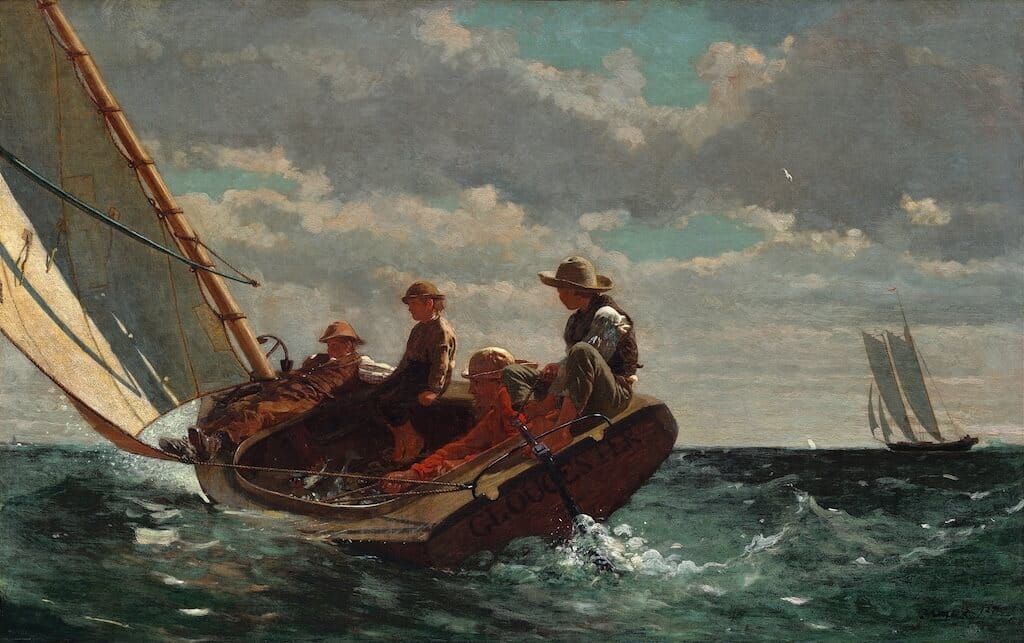
Next off the pile are a neat type of sailing boat I came across while reading about the Skull & Bones society: catboats. They're common on the Eastern seaboard of the USA. This issue's header image is a painting of a catboat (that caught my eye). If nothing else, they make for an interesting detail for a story set in Massachusetts (about students caught up in a Swallows and Amazons type adventure).
As part of researching today's story inspiration, I came across the Order of the File & Claw - a small and anonymous group who broke into the Skull & Bones Society tomb on the Yale campus. They're the only ones other than the bonesmen who've been inside the tomb. The name inspires daydreams of a thieve's guild. As far as their incursion into the tomb goes, it's allegedly full of edgy 19th century nerd stuff. Nothing suspect or conspiratorial, just memelords before twitter was around to provide an outlet for the degeneracy.
The final neat thing for this issue isn't something you can read - it's a small "grab and go gem" called Ta-Ke Don in Melbourne's CBD. It's near my office, and in a week long rampage of weakness, I've been having lunch here. Where else are you going to find a tasty and filling lunch for $10 these days?
The template is tasty, cheap, and effective: a bowl of rice, pick your protein (chicken, tofu, etc), and your sauce (Japanese curry, Thai basil, etc). They have a modicum of seating (3 stools at a short bench), but you'd need to get there 20 minutes before the lunch rush if you want to avail yourself of one. It is one of my favourite places to eat, but not because it's cheap. It's real fast food, and they do it efficiently. I've never waited more than a few minutes for my meal even during the lunch rush when the kitchen is afloat in printed slips and the line stretches out the door.
If you're ever in Melbourne, and in need of a feed...I recommend it. Just watch for the seagulls if you eat in front of the library across the road. They'll swoop down from behind and grab half the protein from your bowl.
Story Inspiration of the week
The story inspiration for this issue comes from a recent dive into one of the more infamous secret societies of Yale university - the Skull & Bones Society. They have a tomb shaped building on campus, have existed for almost 200 years, and are routinely slathered with conspiracy theories about how their members prowl the halls of power advancing an inexorable dark agenda.
In truth, I think the wittering about their members being powerful people post graduation is simply an artefact of their presence at Yale, itself a bastion for the wealthy and powerful to send their scions. That said, the whole mystique of the society lends itself well to a ripping yarn.
In particular, I learned something new about the Skull & Bones - the society owns an island. Deer Island, in the north of New York State, to be specific.
"The forty-acre retreat is intended to give Bonesmen an opportunity to "get together and rekindle old friendships". A century ago the island sported tennis courts and its softball fields were surrounded by rhubarb plants and gooseberry bushes. Catboats waited on the lake. Stewards catered elegant meals."
– Alexandra Robbins
Alexandra Robbins' quote makes a wonderful base for a story location - a private island, a lodge, stewards, catboats. Rhubarb grows wild (and happens to be poisonous, containing high levels of oxalic acid that must be denatured by heat if it is to be safe to eat).
It has all the elements of a story of secrets, betrayal, murder most foul, and all driven by the moral decay of growing up surrounded by extreme wealth.
To really turn up the inspiration for moral decay, I'll end with a quote from C. G. Jung – "Every Roman was surrounded by slaves. The slave and his psychology flooded ancient Italy, and every Roman became inwardly, and of course unwittingly, a slave. Because living constantly in the atmosphere of slaves, he became infected through the unconscious with their psychology. No one can shield himself from such an influence."
I’m glad you’re here,
Justin
This work is licensed under CC BY-SA 4.0
No spam, no sharing to third party. Only you and me.